You rarely sell to a company. You sell to a buyer group inside it.
A tiering model for marketing to technical buyers and senior technical decision makers: how to define your ICP by vertical, size and tech stack, and land-and-expand through IT and engineering buyer groups rather than whole companies.
Ben Rees - 16 August 2026

Most companies scaling past Series B tier their accounts by revenue. That's the wrong variable to start with, and it's why so many ABM programmes stall: revenue is a lagging indicator, it tells you who already bought, not who's going to.
What actually predicts a good account
At a previous employer, tiering 81,954 companies that had ever bought something from us, the answer wasn't revenue. It was three things: vertical, company size, and tech stack. A healthcare company with 8,000 employees and 3,000-4,000 of them in IT will buy completely differently to a retailer with 10,000 employees and 200 in IT, even if their revenue looks identical on paper. One of those companies is going to have a formal buying committee, a business case, and a multi-team rollout. The other might buy twenty licenses over three years and never speak to anyone.
Get the definition right and the numbers sort themselves out. In our data, 51% of $100K+ accounts, 68% of $300K+, 80% of $500K+, and 100% of $1m+ spenders all came from organisations over 10,000 employees. That's not a coincidence, it's the buyer group getting bigger as the org gets bigger.
Selling to technical buyers: the buyer group, not the company
Here's the part most tiering models skip: you rarely sell to a company, you sell to a buyer group inside it (Forrester Decisions, formerly SiriusDecisions, calls this a "demand unit"). In B2B software, that buyer group is usually made up of technical buyers, IT and engineering teams, evaluated and signed off by the senior technical decision makers above them. A large healthcare org isn't one account, it's several of these teams, each with its own need. One team wants change automation, another wants monitoring, a third wants provisioning. Each has its own budget conversation.
That reframe changes how you land an account. You don't try to sell the whole org on day one. You land one buyer group with a specific need, prove the value inside that team, and then expand: change automation this quarter, monitoring next, provisioning after that. Each landed team makes the next one easier, because the second and third teams inherit the credibility the first one built.
The tier model
Once vertical, size, and tech stack sort your accounts, the tiers fall out naturally:
- Tier 1a - perfect ICP fit, already spending. Actively expanding.
- Tier 1b - perfect ICP fit, not yet landed. The priority prospecting list.
- Tier 2 - fits the ICP, lower engagement or spend so far. Programmatic ABM and demand gen.
- Tier 3 - everyone else who's ever bought from you. Inbound only, no active prospecting.
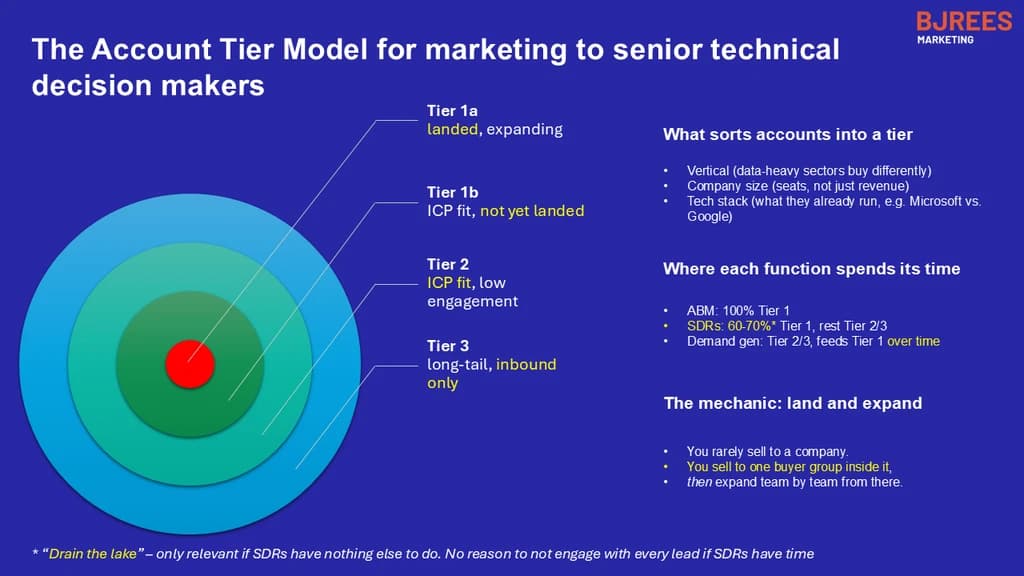 The Account Tier Model from BJREES.COM
The point of naming the tiers isn't the naming, it's what it lets you do with team time. There, ABM spent 100% of its time on Tier 1. SDRs split 60-70% Tier 1, the rest working Tier 2 and 3, and even that split was conditional: I called it "draining the lake", only worth doing once every Tier 1 lead had been worked, never a reason to sit on a Tier 2 or 3 lead just because it wasn't the priority tier. Demand gen ran the programmatic campaigns that kept Tier 2 and 3 fed, quietly promoting accounts into Tier 1b as they showed real engagement. Nobody on the team was guessing where to spend the next hour.
Why this matters more once you're past Series B
Below Series B, one tier is usually enough, you're small enough that everyone gets roughly the same treatment. Past that point, the team is still small relative to the account list, and without a tier model every account looks equally urgent, which in practice means the loudest account wins, not the best one.
The tier model is the thing that lets a five-person marketing team stop treating every inbound lead the same way a 500-person enterprise account gets treated. It's the same discipline the Marketing Pyramid applies to channels, applied to accounts instead: not every account deserves the same investment, and pretending otherwise is how teams spread themselves too thin to land the accounts that actually matter.
Related reading
Scaling from SMBs to the Enterprise - a 10-Point Plan
The challenges of scaling B2B marketing past Series B: a 10-point checklist drawn from five years doing it at Redgate.
Focus on Marketing Effectiveness to Scale Up
For a scaling business, chasing efficiency is the wrong goal. Binet and Field's case for effectiveness over ROI optimisation.
Why AI systems cite some SMB-to-enterprise stories and ignore others
AI systems rarely cite customer case studies that only live on the vendor's own site. Citation comes from independent corroboration, not content quality - here's what to do about it.
Selling to the Boss
Selling to senior decision makers takes far longer and is far harder to measure than selling to end users. A five-step model for the process.