How to build a B2B marketing team
How to build a B2B marketing engine from scratch, what a VP of marketing actually does day to day, and what makes a great CMO: choose your strategy before you build the team, the shape of the strategy determines the people you need, not the other way round.
Ben Rees - 3 July 2026

Most people build the team first and the strategy second. Then they wonder why the team doesn't work.
It should run the other way. You choose a strategy, and the strategy tells you the team you need. Get that order backwards and you end up with a marketer whose skills don't match the bet the business is actually making, which is the single most common failure mode I've seen in B2B marketing hiring.
That's the whole job, in miniature: building a marketing engine from scratch means choosing the engine's shape before you choose its parts.
The five strategies, and what each one actually costs in people
I use a framework I call the Marketing Pyramid to work out where to focus. It ranks five approaches from most targeted to broadest reach: events, paid social, search (Google ads), account-based marketing, and content.
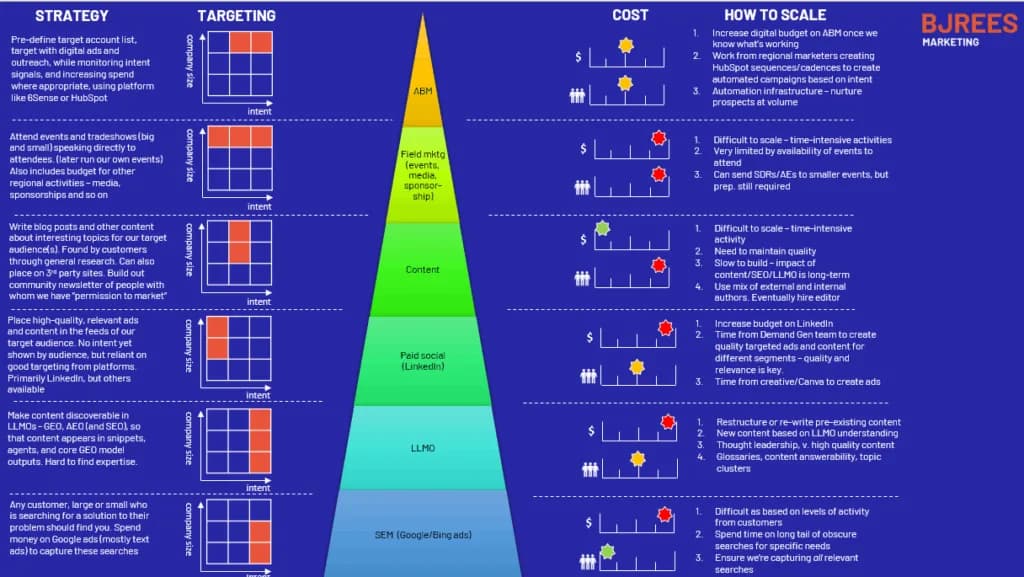
Each one has a different shape, and the shape is what determines the team, not the other way round.
- Events - the narrowest and most labour-intensive strategy. Attending well, let alone running your own, eats time that doesn't compress: someone has to be there, in person, and that doesn't scale by adding budget.
- Paid social - broader than events, but needs a different kind of person: someone who can produce quality, segmented creative quickly, because the platforms reward relevance over reach.
- Search (Google ads) - sits in the middle. It's less about people and more about coverage, catching the long tail of specific searches your buyers are already running, which means the work is closer to maintenance than creation once it's set up.
- Account-based marketing (ABM) - needs the most coordinated team of the five: a pre-defined account list, intent monitoring, and outreach that's automated enough to run at volume but personal enough to convert. In practice that means someone in marketing operations as much as someone in demand generation.
- Content - the cheapest per unit once it's running, and the broadest reach of the five. But the people who can do it well, consistently, are hard to find and slow to develop, which is exactly why it's usually underinvested in relative to its long-term payoff.
The mistake is treating this as a menu you can order all five items from at once with a five-person team. You can't. I wrote about this in more detail here: more money doesn't fix your hiring process, and more money doesn't produce better content, and more money definitely doesn't fix your culture. It usually does the opposite. Pick the strategy your starting position actually supports, then build the team that strategy requires, not the team you'd like to have.
How to hire your first marketing team, in order
Early on, the temptation is to hire your dream specialist: the brilliant demand gen lead, the ABM expert who worked at a name-brand company. Resist it.
A specialist hired before the strategy is settled will optimise for the thing they're good at, not the thing the business needs. I've watched this happen: a genuinely talented paid media specialist joins a company that hasn't decided if paid is even the right strategy, and six months later there's a beautifully run campaign that nobody can tie to a business outcome.
- Hire one: a generalist. Someone who can do a bit of everything competently while the strategy is still being tested, comfortable writing content one day and running a small ad budget the next. Their job in the first six months isn't to execute a plan. It's to help you find out which of the five pyramid strategies actually fits your starting position, by trying enough of them cheaply that you can be wrong quickly rather than slowly.
- Hire two: still broad, not a specialist. This is where it gets tempting to specialise too early. Don't. The second hire should still be broad, but weighted towards whichever strategy hire one's experiments suggest is working. This is also, in my experience, the point where a lot of teams skip a step they shouldn't.
- Hire three: an operator. Not another marketer - see the next section for why this is the hire most teams skip.
The most useful hire nobody wants to make
There's a headcount decision I made early that I'd make again: hire the admin and operations support before you think you can afford it, not after.
My own notes from a board discussion on this put it plainly: senior people were spending their time on low-level admin tasks, and the fix wasn't more senior hires, it was one or two people whose job was to remove that admin load so the experts could work at the level they were hired for. That single move freed up more senior capacity than the next specialist hire would have.
It's an unglamorous hire. Nobody puts "hired an ops coordinator" in their highlights reel, and it's rarely what the board is asking for when they push for growth. But it's usually the highest-leverage headcount decision available to a small team, because it's the one that gives your existing senior people back their time rather than adding a new voice to coordinate. Almost everyone skips it because it doesn't feel strategic, right up until the point where it obviously should have been the first strategic decision made.
Only after the operational load is off your senior people's plates does specialising make sense. By then you also actually know what you're specialising in, which is the entire point of doing it in this order rather than the reverse.
What does a VP of marketing do in a B2B company?
The job description says "own the marketing strategy." The real job is different: translating board pressure into a sequence of decisions the team can execute, and being honest about the trade-offs.
Every quarter the same questions come up. How do I make an impact soon? What can I show that proves progress on a long-term objective? Where are the quick wins that keep the board onside? What can I do with money, and what can I do without it? Answering those well, repeatedly, is most of the job. Building slide decks and attending the odd trade show is the visible ten percent.
The harder, less visible part is saying no. A board under pressure will ask for all five pyramid strategies at once, because from the outside they all look like reasonable requests. Part of the job is holding the line on sequencing: this quarter we're proving out content, next quarter we revisit paid, not because paid is a bad idea but because running both badly is worse than running one well. That's an uncomfortable conversation to have repeatedly, and it's the actual differentiator between VPs who keep the board's confidence and VPs who don't.
A 2014 Harvard Business Review study of over 10,000 marketing executives found that 52% of respondents at overperforming companies said marketing was regarded as a strategic partner for business growth, versus just 38% at underperforming companies, a 14-point gap (de Swaan Arons, van den Driest & Weed, "The Ultimate Marketing Machine," HBR, July-August 2014).
That gap between perception and reality is also why marketing's seat at the leadership table is inconsistent from company to company. Where marketing is treated as a genuine strategic partner rather than a service function, it tends to be because a VP earned that seat by being right about trade-offs repeatedly, not because of the org chart.
The other part of the job that rarely makes it into a job description is translation in the other direction: taking what the team is actually capable of, given their current skills and capacity, and turning that into commitments the board will find credible. Overpromise based on what you wish the team could do, and you spend the next two quarters explaining the gap. Underpromise, and you lose the argument for more resource next time you need it. Getting that calibration right is a skill that only comes from having been wrong about it before.
How to structure a marketing team at a scale-up
The question I get asked most often isn't whether to specialise, it's when, and into what shape.
The honest answer is: later than you think, and around function, not seniority. At a genuine scale-up, once the generalist-plus-operator stage is behind you, the structure that tends to work splits by discipline rather than by campaign or by product line:
- Product marketing - owns the go-to-market story.
- Digital marketing - owns paid and organic execution.
- Brand - owns consistency of message and design.
- ABM - owns the named-account motion.
- Customer marketing - owns retention and expansion messaging.
Marketing operations threads underneath all five, keeping the systems and data honest.
That's not a template to copy wholesale from day one. It's the shape a department settles into once it's big enough that a single generalist can no longer credibly cover more than one of those disciplines at depth. Trying to impose that structure too early just creates five under-resourced half-functions instead of two or three that are actually good.
What changes at 2, 45, and 400 people
Team structure isn't a fixed template. It's a function of company size, and I've worked across most of the range.
At a two-person startup, there is no structure. I did product management, marketing, some development, whatever needed doing to find product-market fit. There's no time to ask "how would I do this better next time?" because the rollercoaster doesn't stop, and three years in, your depth in any single discipline can still be close to zero, because survival mode never gave you the chance to specialise.
At a department of around 45, the shape from the previous section becomes real: distinct functions, each with its own discipline and its own person, and enough scale that the company can justify running an internal conference purely devoted to levelling up marketing skills across the team. That transition has parts nobody warns you about: a two-person startup and a 400-person corporate can both stunt your growth for the same underlying reason, just from opposite directions.
At the largest end, a corporate the size of an airline, the opposite problem to the startup shows up: every process has already been figured out by someone, years before you arrived, down to the precise file-naming convention for a routine document. Growth and individual influence are inversely related past a certain point. The bigger the team, the less any one person's judgement moves anything, and the harder it becomes to change even an obviously outdated process.
The fourth team member nobody puts on the org chart
The most recent team I ran was small on paper: roughly two and a half full-time equivalents across three people, working four or five days a week each. Near-zero redundancy. One person out removes a third of the team's capacity.
What made it work wasn't heroics. It was clear ownership (one person on strategy and positioning, one on content execution, one on production and visuals) and a deliberate fourth member that never appears on a headcount spreadsheet: AI doing the prep work a fourth hire would otherwise have done, with a human approving everything before it shipped. Asset reuse, cross-training on basic publishing tasks, and batching content ahead of gaps in coverage did the rest.
That's not a hypothetical for the future of marketing teams. It's already how a well-run lean team operates today, and it's worth designing for deliberately rather than discovering by accident when someone's on holiday.
What are the key qualities of a great CMO?
Not vision. Not charisma. The ability to look at the pyramid, be honest about which strategy the business's starting position actually supports, and build only the team that strategy requires, no more.
The bad CMOs I've seen all made the same mistake in different clothes: hiring ahead of the strategy, or hiring a mirror of the last company they worked at rather than the one they're now in. The good ones treat team-building as a downstream decision, not an upstream one.
Before you write the next job spec, go back to the pyramid and ask which strategy you're actually betting on this quarter. The team follows from that answer. It shouldn't come first.