B2B marketing strategy for scaling companies: the Marketing Pyramid
How to choose a B2B marketing strategy for scaling companies without infinite budget: the Marketing Pyramid framework for prioritising events, paid, search, ABM, and content.
Ben Rees - 7 June 2023

Scaling up marketing is tough. You've missed the fun of the early days where you can try a new thing each week and you've not yet reached the safety of a well established brand. The board will be on your back, expecting enormous growth yesterday when you know in your heart that building a brand takes time.
Assuming you don't have infinite budget, infinite resource and a super-experienced team sitting there waiting for their next job, you need to prioritise. And to prioritise you need a strategy. Part of choosing a strategy is looking at your starting point. What are your unfair advantages? Where are you weak? Trying to start from scratch where you don't have the expertise or traction in the market can be very tough, particularly if the board want results ASAP.
I use the diagram below as a way of focusing efforts where it's needed:
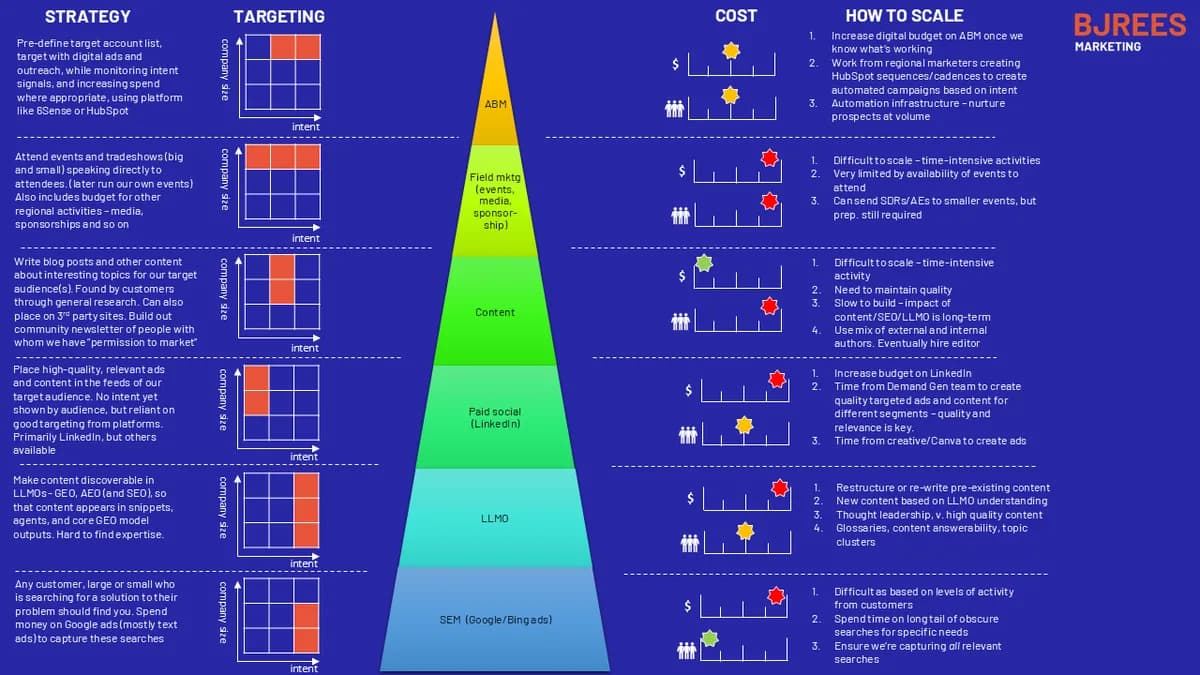 Marketing pyramid v3
Click here to download a copy.
To help navigate this diagram a little:
- There are five strategies listed from top to bottom. The further down the list you go, the less targeted the strategy becomes, though of course you are casting a wider net.
- From left to right, the diagram provides a summary of what the strategy actually is, a grid showing where the strategy is most effective (is it better for large or small companies? And is it better for companies who already know what they want?), then most importantly, the cost of the strategy both in terms of budget but also in terms of the number of people you need to implement it effectively.
- Crucially, when looking at costs you have to look both at the financial cost but also the number of people you need. To take a simple example, Google ads don't need a large team to implement and maintain. However they cost a lot, whether you believe they are effective or not. In contrast, high quality content is cheap if not free to create. But you need a team of very talented people for this to be effective.
- Finally I've put in a column of “how to scale”. Not everything can be scaled by pouring more money in. More money won't give you higher quality content. More money won't fix your hiring process. More money won't fix your culture (in fact it does the opposite). When looking at how to scale it's crucial to do the strategic diagnosis first of what you are capable of doing as an organisation, where the real problems are and so on. Without this you'll burn everybody out, but also it will take far too long to hit the targets that you have.
This is where the real skill comes in, in senior marketing roles. How do I make an impact soon? What numbers can I show that actually show progress for a long term objective? Where are the quick wins to keep the board onside? What can I do if I've got pots of money? What can I do if I haven't?
Search for advice on how to prioritise a B2B marketing strategy and most of what ranks is a generic numbered list: five tactics, no order, no acknowledgment that a five-person team can't run all five well at once. The pyramid above isn't a list, it's a ranking, and the ranking is the entire point. Picking the strategy your starting position actually supports, and building only the team that strategy requires, is the difference between a plan that survives contact with a real budget and one that doesn't.
I've provided various resources which will hopefully help scaling up marketing. Otherwise get in touch to see if I can help.
Related reading
Scaling from SMBs to the Enterprise - a 10-Point Plan
The challenges of scaling B2B marketing past Series B: a 10-point checklist drawn from five years doing it at Redgate.
Why AI systems cite some SMB-to-enterprise stories and ignore others
AI systems rarely cite customer case studies that only live on the vendor's own site. Citation comes from independent corroboration, not content quality - here's what to do about it.
Focus on Marketing Effectiveness to Scale Up
For a scaling business, chasing efficiency is the wrong goal. Binet and Field's case for effectiveness over ROI optimisation.
Testing whether I should reuse old content
I fit a hierarchical Bayesian model to test whether retitling old content for AI citation works, and a robustness check collapsed the one clean result it found.