My Mac Mini is going back to the shop
Three separate experiments on the same Mac Mini all pointed at the same conclusion: free and private don't matter if the answers are wrong or don't arrive at all.
Ben Rees - 8 September 2026

My Mac Mini is going back to CeX. Not because the hardware failed. Because three separate experiments on it, over six weeks, all pointed at the same conclusion: free and private don't matter if the answers are wrong, or don't arrive at all.
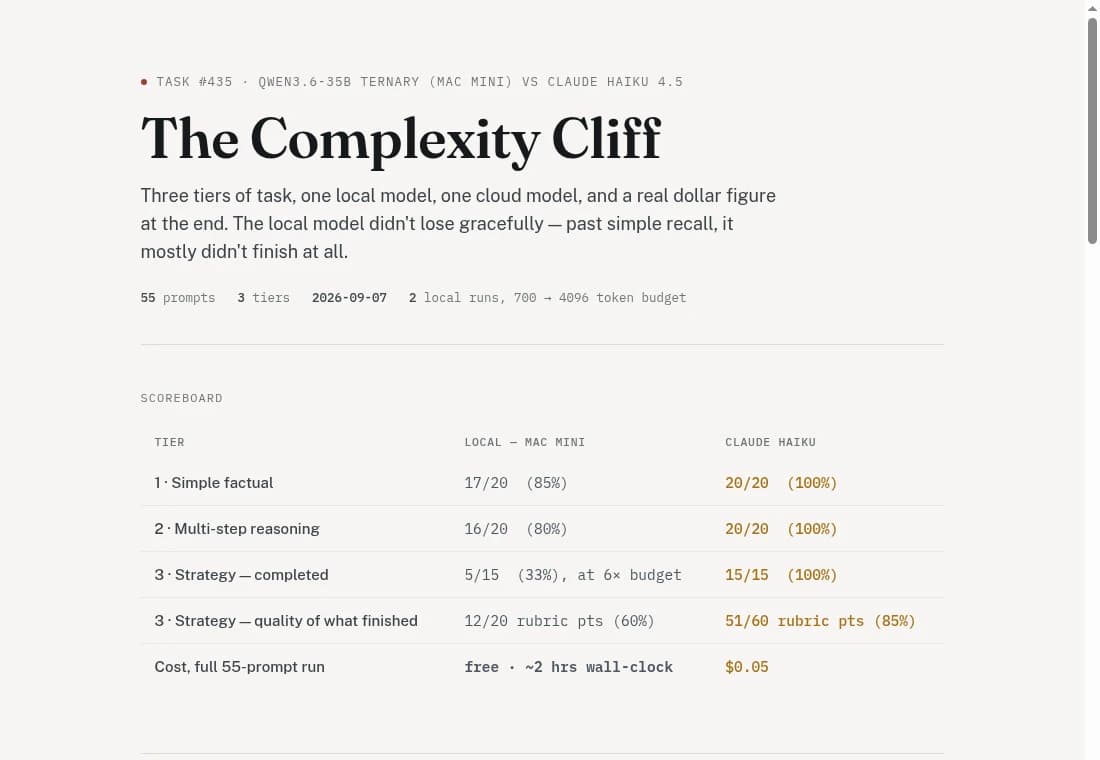 The full task-complexity probe results (PDF)
The idea was reasonable
I bought the Mac Mini in July for one specific reason: hours of spare overnight compute I wasn't paying cloud API rates for, and a working hypothesis that a weak model given unlimited time could trade wall-clock hours for reasoning quality it doesn't have on a single pass. I got a 35-billion-parameter model running on it at roughly reading speed, ternary quantization compressing 431 layers down to one of three values per weight. It worked. It also confidently told me GEO stood for "Global Economic Opinion," the first sign that "it runs" and "it's useful" are different claims.
Two real wins, both banked before this one
The next question was whether compression itself was safe to trust. I built a 298-prompt probe, country capitals and chemical elements, tiered by how obscure they are, and ran it across four precision levels. Eight-bit compression was nearly free: 63.4% down to 62.1%. The real cliff sat between eight-bit and four-bit. The practical result mattered more than the theory: the 35B model at ternary (80.2%) beat the 0.5B model at full precision (63.4%) on the identical test, real evidence that compressing a big model beats running a small one uncompressed.
Then I tested whether the machine could sustain long, unsupervised work at all. A recursive self-refine loop, the same brief run twice for six and a half hours each: generate fifteen content ideas, critique them, revise, repeat. The first run collapsed into reciting its own instructions by cycle 179. The second, with one sampler setting changed, held clean for all two hundred and one cycles.
Both results were real, useful, and already published. Neither told me what I actually needed to know.
The test I hadn't run yet
Everything so far tested recall, does the model remember the fact, or stability, does the loop break. Neither tests the thing I actually wanted this machine to eventually do: take an open-ended, judgement-heavy brief, hiring sequencing, account tiering, a board conversation about marketing ROI, and produce a usable answer.
So I built a third probe. Twenty simple facts. Twenty multi-step reasoning problems, arithmetic and logic puzzles with one verifiable answer. Fifteen real strategic scenarios grounded in my own frameworks, each graded against a short rubric of what a genuinely good answer has to contain.
What actually happened
Simple facts: 85%. Multi-step reasoning: 80%. Both fine, both roughly what I expected.
Sophisticated strategy: zero finished answers out of fifteen. Not fifteen wrong answers. Every single one burned its entire budget planning and never reached a conclusion. Recent research on quantised reasoning models found the same shape of result: compression that barely touches simple benchmarks does real damage once a task needs actual multi-step reasoning rather than recall. My own numbers were a much starker version of the same finding.
I gave it six times the token budget and applied the exact fix that had saved the self-refine loop. Five of fifteen finished this time. The other ten either ran out of room again, mid-thought, or collapsed into repeating themselves. Asked about the risk of a stale customer profile, one spent its entire budget on this, until the tokens ran out:
disauthenticatedededed. Disauthorize disauthorizedededed. Dispermission dis
Another got stuck in the same kind of loop for four thousand tokens:
(Proceeds.) (Writing...) (Okay.) (Go.)
The fix that worked in August didn't reliably work in September, on a different shape of task.
The number that actually decided it
I ran the identical fifty-five prompts against Claude Haiku, the cheapest model Anthropic sells, as a direct comparison. Every strategy prompt finished. 85% of the grading criteria were met, against 60% for the five local answers that even completed. The whole fifty-five-prompt run, measured by the API's own token counts rather than estimated, cost five and a half cents.
Scaled to match the self-refine loop's actual pace, roughly six hundred calls for a six-and-a-half-hour equivalent workload, that comes to somewhere around a dollar fifty to two twenty-five. For six hours of work that would occupy the Mac Mini and might not finish at all.
Security doesn't help if there's nothing to secure
Arkes and Blumer's 1985 study of sunk cost found that people keep funding a failing course of action in proportion to what they've already put into it, not in proportion to whether it's working. I'd already spent six weeks and two blog posts on this machine. That is exactly the condition under which the honest answer gets hardest to hear.
The honest answer: past simple factual lookup, the local model can't be trusted to finish a response, let alone a good one, even with every fix I know applied. Cloud finishes every time, costs cents, and does better work. The one thing local still has, that cloud structurally cannot, is privacy: nothing running on my own machine ever touches someone else's server. But privacy is a property of the infrastructure, not of the answer, and it is worth nothing attached to an answer that never arrives.
The Mac Mini is going back to CeX. What stays is the actual finding, and the two posts it had already paid for before I found it.
Related reading
The fix for a spiralling AI bill is rarely a cheaper model
Most AI cost overruns come from asking the same easy, judgement-free question over and over through an expensive interface, not from asking anything genuinely hard.
Who Owns the Stack
The full sourced and scored expansion of September's one-page stack audit: ownership, funding, open-source status, enshittification evidence, and military ties for every tool bjrees.com and Klara depend on.
I turned a 40-year-old ZX Spectrum cassette into an A3 art print. Here's how.
Spectrum tapes aren't music, the sound is data. Here's how to decode the original bytes off a 40-year-old cassette and turn them into a printed piece of art.
If you're publishing your GEO content last, you're handing authority to someone else
Publishing GEO content after your AEO infrastructure is built is the wrong sequence. Parametric memory gets encoded during training, not at retrieval time.