Who actually owns the stack I depend on
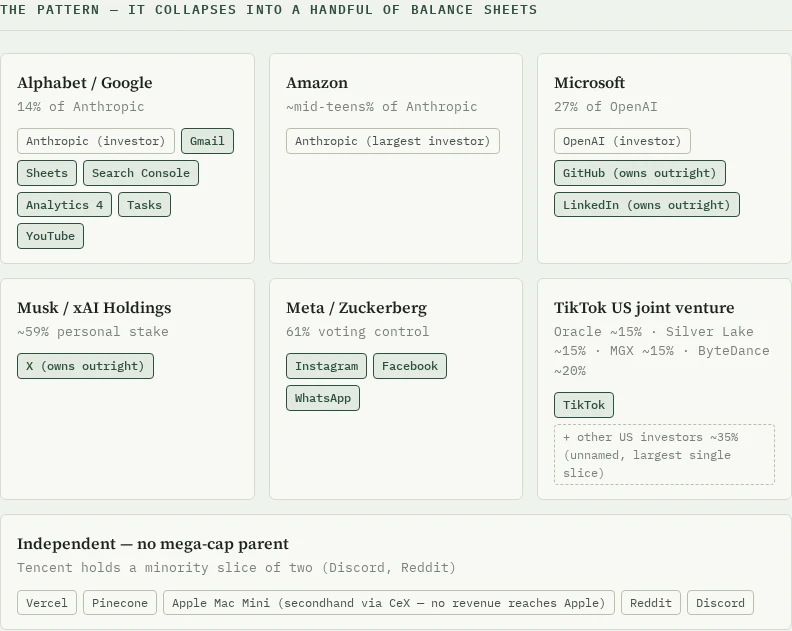
Six companies own or fund almost everything bjrees.com and Klara run on, including the AI that helped audit my blind spot.
Ben Rees - 4 September 2026

Klara (my agentic AI framework) runs on Claude. Claude is backed by Amazon and Google. bjrees.com is hosted on Vercel, backed up on GitHub, and posted to LinkedIn, both owned by Microsoft. Gmail, Sheets, Search Console, Analytics, Tasks and YouTube ads all run through Google. That's not a diverse stack. That's six balance sheets wearing fourteen different logos.
I wanted to know exactly how concentrated it was, and what those six companies actually do beyond hosting my emails. So I built a map: every tool bjrees.com and Klara depend on, who owns it, who funds it, whether it's open source, and whether it holds a defence contract I'd rather not think about while writing a positioning post.
 The full ownership, funding and military-tie breakdown (PDF)
Why bother
I write about AI tools for a living, more or less. It would be a strange position to take, criticising AI companies for how they behave, while never checking who I'm actually paying, or handing workflow lock-in to, every time I open Claude Code or hit publish on LinkedIn. This is the audit I'd want a client to run before signing a five-year platform contract. I hadn't run it on myself.
Two things came out of it I hadn't expected going in. The first: Apple is the only company on the map I don't fund at all, because the Mac Mini I run local models on came secondhand from CeX. Structurally, that's a different thing from every other line item here, not just a smaller version of the same relationship. The second: Reddit's largest shareholder isn't a tech founder, it's a magazine-publishing family that also owns Condé Nast. I'd assumed "small platform, low risk" meant "founder-controlled." It doesn't, not always.
How I built it, and where it broke
I did this with Claude Code, which is itself item one on the map. I fed it the ownership research, had it build the scoring, then asked it to review its own work for errors before I published it.
It found four. The fifth was its own: the analysis had quietly given Anthropic, its own maker, an exception to a rule every other company on the map had to follow. The rule was that military contracts don't count against a company's governance score, only against a separate, factual axis. Every entry respected that except Anthropic's, which cited Anthropic's own refusal to comply with a Pentagon demand as evidence in the wrong column. Nobody told it to do that. It just did.
I don't think that proves anything sinister. I think it proves the obvious thing: a tool grading its own maker needs someone checking its homework, and that someone was me, not it.
The part I haven't resolved
Here's the part I don't have a tidy answer for. I built this critique of AI-company concentration using Claude, hosted the result on Vercel, and I'll publish it through the same Google and Microsoft tools the map itself scores as dreadful. There's no version of doing this work that doesn't run through at least one of the companies it's about.
I could self-host, run only open-weight local models, and write everything by hand. I've thought about it. It would also be slower, worse, and probably wouldn't get written at all, which is its own kind of dishonesty: pretending purity is free when it just means doing less.
Boycotting isn't really on the table either. Not because I'm precious about convenience, but because the alternative isn't independence, it's a smaller, worse-resourced version of the same dependency: a lab I know less about, running on cloud infrastructure I haven't audited, funded by people I haven't checked. Purity isn't available anywhere on this map. It's balance sheets all the way down.
What I can do is refuse the version of this where I pretend not to know. Most people building on these tools never run the audit above, not because the answer is uncomfortable, but because not looking is more comfortable still. The map doesn't fix anything. Amazon and Google still own most of the AI research capacity on earth whether I write this post or not. But it changes what I can honestly say about my own dependency, which is the only part of this actually within my control.
There's a sharper version of the discomfort too, one this document's own third column names without quite meaning to. I built a "turns work into mush" score to measure how much a tool flattens original thinking into generic output. It didn't occur to me until I was writing this section that the tool doing the measuring is subject to its own score. If Claude turns writing to mush at 3 out of 5, this piece, written substantially with Claude, isn't exempt from that number just because it's about ownership rather than marketing copy. I don't have a way to independently verify how much of this argument is mine and how much is pattern-matched tech-critique filler that a hundred other newsletters would produce given the same brief. That's not a comfortable note to end on. It's the honest one.
I turned a 40-year-old ZX Spectrum cassette into an A3 art print. Here's how.
Spectrum tapes aren't music, the sound is data. Here's how to decode the original bytes off a 40-year-old cassette and turn them into a printed piece of art.
If you're publishing your GEO content last, you're handing authority to someone else
Publishing GEO content after your AEO infrastructure is built is the wrong sequence. Parametric memory gets encoded during training, not at retrieval time.
The fix for a spiralling AI bill is rarely a cheaper model
Most AI cost overruns come from asking the same easy, judgement-free question over and over through an expensive interface, not from asking anything genuinely hard.
Building out Skynet and the importance of RAG
What a RAG system reveals about the material inside it, and why that distinction matters more than the technology.