All my best work is done on runs
..and as a Brucie Bonus, I'm getting fit too, as long as I stretch - https://youtu.be/u-e0ZO5L0s0
Ben Rees - 16 September 2026

The AI agent that plans my week, writes my Sunday-night briefing, and decides what I should work on Monday morning was never designed. There was no whiteboard session, no architecture doc, no moment where I sat down and specified what it should do. It started as a stray question in the middle of a voice note that was mostly about a completely different work problem, on a run I'd have taken anyway. I only found the recording again months later, long after the thing it described was already built and running every night without me.
That's not a story about a good idea. It's a claim about where my actual thinking happens, and it isn't at a desk.
The route
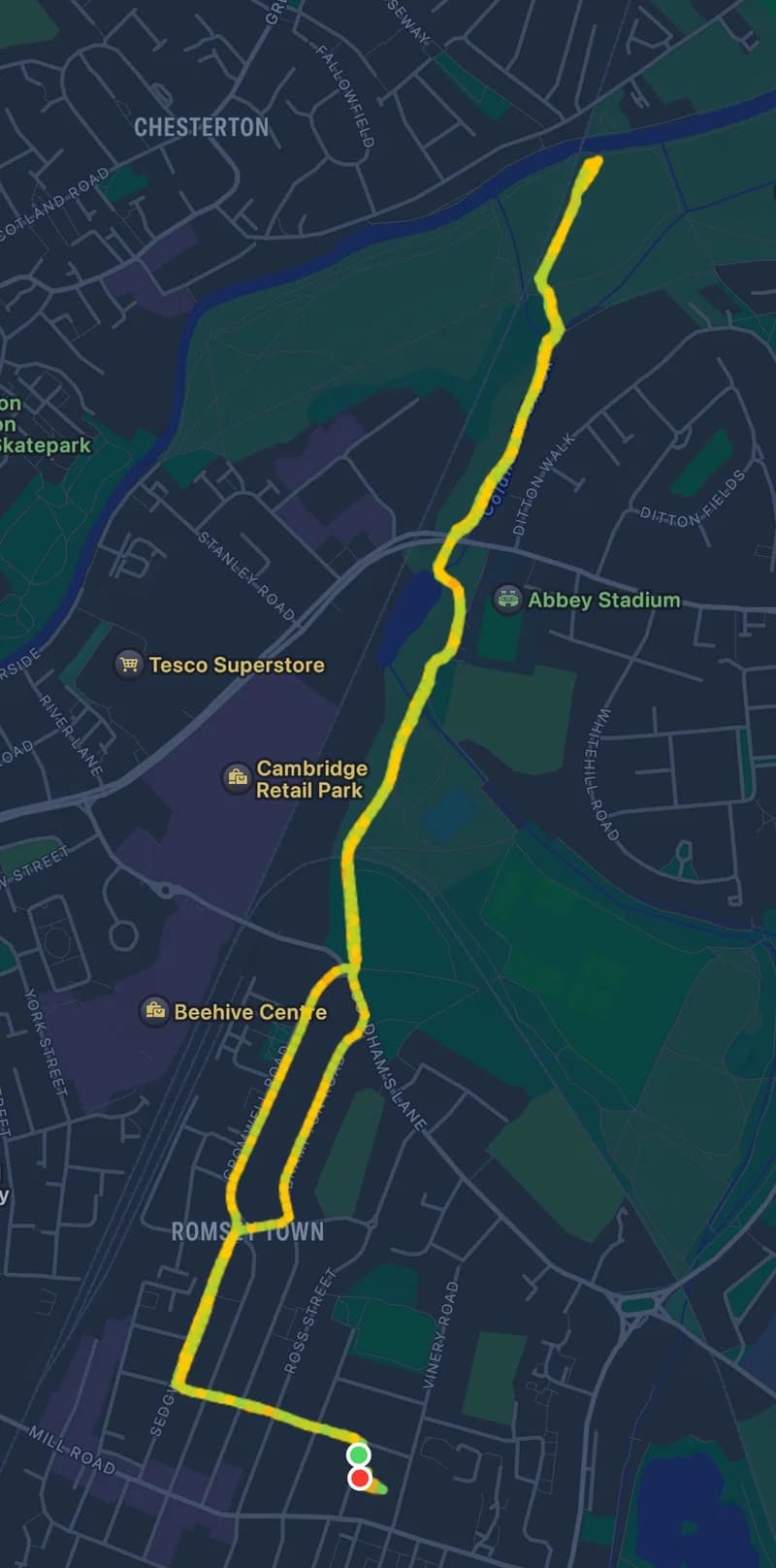
Out and back, always the same shape. Start in Romsey Town, past the Beehive Centre and the retail park, onto the river towpath, north past Abbey Stadium, up toward Chesterton, then back the way I came. I've never timed how long it takes and I'm not going to start now. The point isn't the run. The point is that the route is fixed enough that I don't have to think about where I'm going, which frees up the part of my brain that would otherwise be doing that.
The keyboard is the problem
At a desk, you edit as you think. A sentence starts, you don't like the shape of it, you delete it and start again before it's finished. That's a useful skill for writing. It's a terrible way to work through an idea, because you never let the idea get all the way to its ugly, half-formed conclusion before deciding whether it was any good. You clean it up before you've found out.
On a towpath at 6am, there's no delete key. You can't open another tab, check Slack, or bail out to something easier the moment an idea gets hard. You either think it through to the end or you don't think about it at all. Most days I do.
Why a dictaphone and not my phone
I record onto a Sony digital voice recorder, not my phone. It's a Japan-only model, which means the display only shows kanji, which I can't read, which means I have genuinely no idea what mode it's in half the time. I've learned to trust the record light. It sounds like a downgrade. It isn't. A phone voice memo competes with every other thing a phone can do, and gets abandoned the moment something more interesting shows up on the lock screen. A dedicated device with one function and an unreadable screen has no competing use case. The friction is the feature.
The recordings get transcribed automatically and fed into my own knowledge base, the same pipeline I've written about before. I'm not going to re-explain the mechanics here. What I want to explain is what actually comes out of it.
The question that became the system
The recording is from an April run, and it isn't about AI at all for most of its length. It's mostly me working through an unrelated problem with a former team. Buried in the middle of it, almost as an aside, is a single question: could I pull everything I'd read, heard, and written overnight into one place, running automatically, so I wasn't starting Monday morning from a blank page and a pile of scribbled notes?
I didn't act on it that day. I didn't act on it that week. But it's exactly what the system does now, every Sunday night, without me touching anything. The gap between the question and the thing itself was months, and in that gap I never once sat down and deliberately designed it. The design was already finished the moment I said it out loud. Everything after that was just building what I'd already specified to myself on a towpath.
It happened again a few weeks later, on a different run: a half-formed wish that I had some way to prove the changes I make to a page actually move the numbers, instead of just assuming they do. That's now a real, working protocol that tracks a page from the moment I edit it and measures whether visibility genuinely shifts. Small detail, same pattern: it started as a complaint I'd never have written down at a desk, because at a desk I'd have edited it into something safer before it finished forming. Even the rule against em dashes in anything this system writes traces back to the same run, the same restless, unedited mode of thinking, applied to something far smaller.
The pipeline is not perfect, and that's fine
For a while, every transcription of the word "Klara" came back as "Clara." Eight voice notes, all wrong, all confidently transcribed by a system that had simply decided that was the more plausible word. I only caught it because I went looking. It's a small, slightly embarrassing failure of a pipeline I otherwise trust completely, and I think that's worth saying plainly rather than pretending the system is cleaner than it is. Voice-to-text is good. It is not infallible, and treating it as infallible is how errors like that survive for months.
Constraints that look arbitrary usually aren't
The 6am start, the fixed route, the single device with the screen I can't read: none of that looks like a productivity system. It looks like a collection of small inconveniences. But the value was never in giving myself access to more information. Most of what my knowledge base runs on is stuff I already knew, said out loud on a run I'd have taken anyway. The value is in giving it access to me: the version of my thinking that only shows up when there's no keyboard to edit it into something more presentable first.
Daoism and Marketing Planning
Why the annual marketing plan gathers dust by February, and what the Dao of Complexity gets right about planning for emergence instead.
My Mac Mini is going back to the shop
Three separate experiments on the same Mac Mini all pointed at the same conclusion: free and private don't matter if the answers are wrong or don't arrive at all.
Who actually owns the stack I depend on
Six companies own or fund almost everything bjrees.com and Klara run on, including the AI that helped audit my blind spot.
A Weighted Sum of Everything Ever Written About You
What Bayesian linear regression, copied by hand from a textbook I've owned since January 2007, tells us about getting cited by AI.