A Weighted Sum of Everything Ever Written About You
What Bayesian linear regression, copied by hand from a textbook I've owned since January 2007, tells us about getting cited by AI.
Ben Rees - 13 July 2026
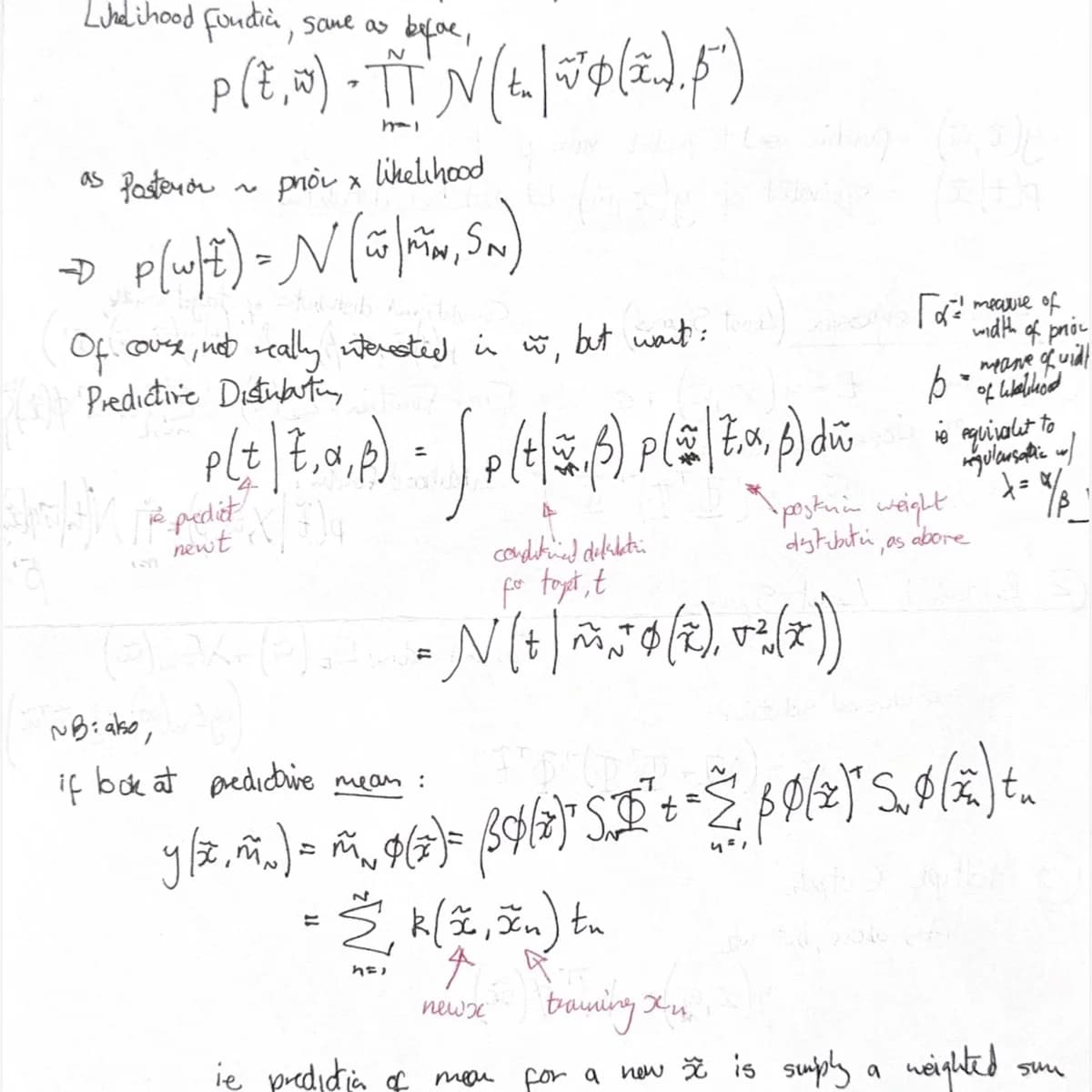
The mechanism underneath everything I've written about AI visibility, worked through properly, with the maths on the page rather than gestured at. Why a language model's answer about your brand is a similarity-weighted sum of its training data, why the standard Bayesian model of brand choice is missing a term that matters once the thing doing the choosing is a language model, and what a diagram I drew by hand, in a textbook I've owned since a month after it was published, has to do with any of it.
↓ Get the PDF (free, just your email)Whitepaper on How to Optimise for AEO and GEO
Results from a two-month experiment testing what actually affects AI answers across ChatGPT, Gemini, Perplexity, Copilot and Google.
Making decisions in a Bayesian world
Most marketing decisions can't be A/B tested. Bayesian logic, combining prior knowledge with whatever data you do have, fills the gap.
There's a precise point where your brand and a competitor collapse into the same thing
A 2026 theory of feature geometry shows superposition isn't a vague crowding problem, it's a specific mathematical collapse. Here's what that means for how much content actually earns its own identity.
All my best work is done on runs
..and as a Brucie Bonus, I'm getting fit too, as long as I stretch - https://youtu.be/u-e0ZO5L0s0