Self-Refine Without a Repetition Penalty
A controlled case study: the same recursive self-improvement loop, on the same local model, six and a half hours each. One run collapses into repetition within forty cycles. The other holds clean for all two hundred and one. The difference is a single sampler setting.
Ben Rees - 11 August 2026
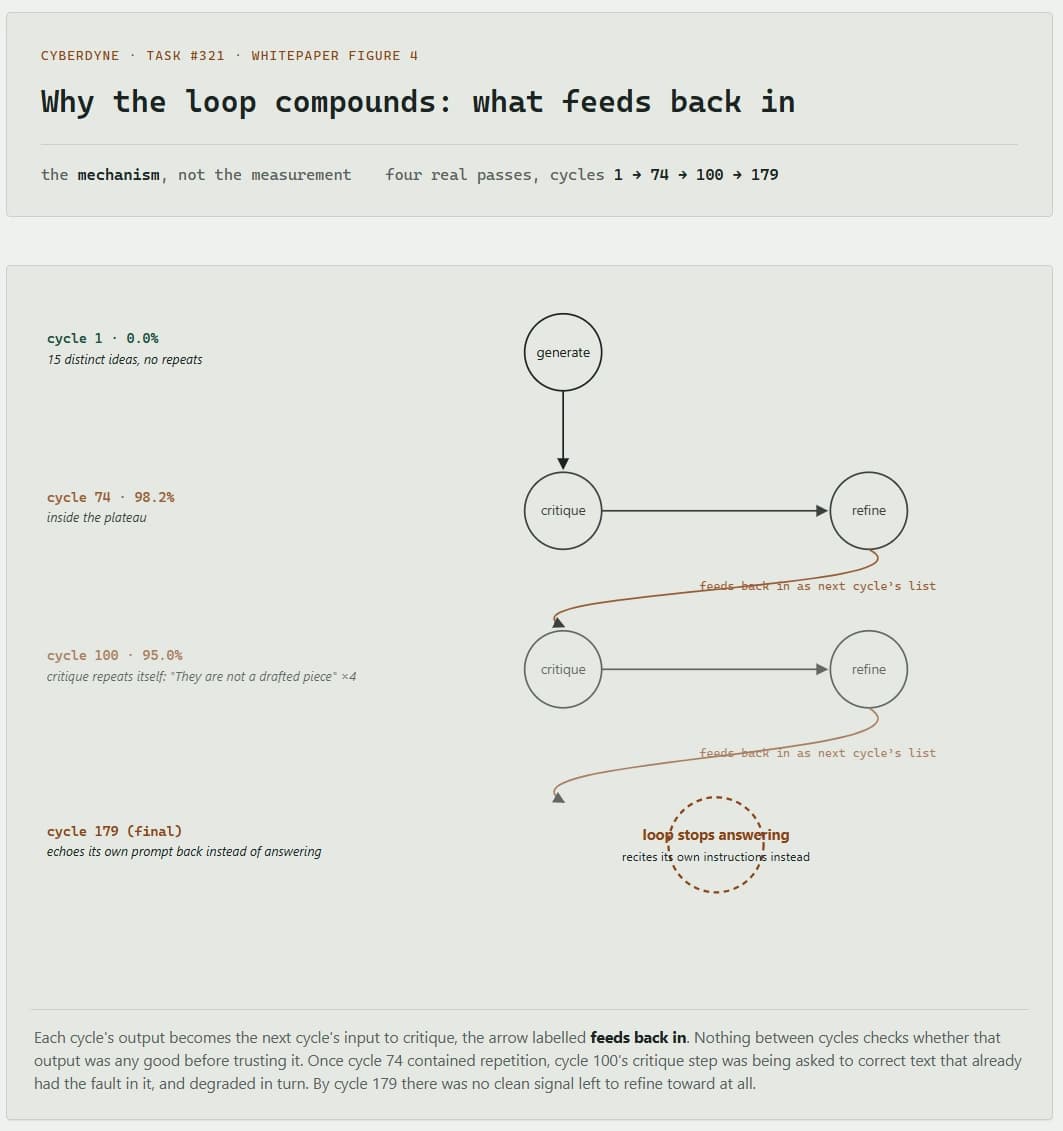
I ran the same recursive self-refine loop on my Mac Mini's local model twice, six and a half hours each, same task, same budget. The first run had no repetition penalty configured and collapsed into repeating itself within forty cycles, by the end it had stopped attempting the task altogether and was reciting its own instructions back. The second run added one sampler setting and a guard against building on degraded output, and held clean for all two hundred and one cycles. The more elaborate half of the fix barely mattered. The cheap one did nearly all the work.
↓ Get the PDF (free, just your email)My Mac Mini is going back to the shop
Three separate experiments on the same Mac Mini all pointed at the same conclusion: free and private don't matter if the answers are wrong or don't arrive at all.
I ran a local AI model through 179 rounds of self-refine. It collapsed. One sampler setting fixed it.
An unguarded local model collapsed into repetition after 179 rounds of self-refine. Adding one sampler setting and rerunning the identical task produced 201 clean cycles instead.
A 35-billion-parameter model now runs on a $599 Mac Mini. That doesn't make it useful for everything.
Ternary quantization gets a 35B open-weight model running on a base Mac Mini at reading speed. It still confidently got GEO wrong, which is the more useful finding.
Human Beings are Holding Back Machine Learning
Machine learning tools have been accessible for decades. The real shortage has always been people who know how to use them properly.