People - the true heart of decent marketing
My talk at The Marketing Meetup's Cambridge chapter argued that AI visibility is a brand problem, not a content problem, backed by 5,095 real citation checks showing two published articles that never moved a single query they were written for.
Ben Rees - 27 September 2026
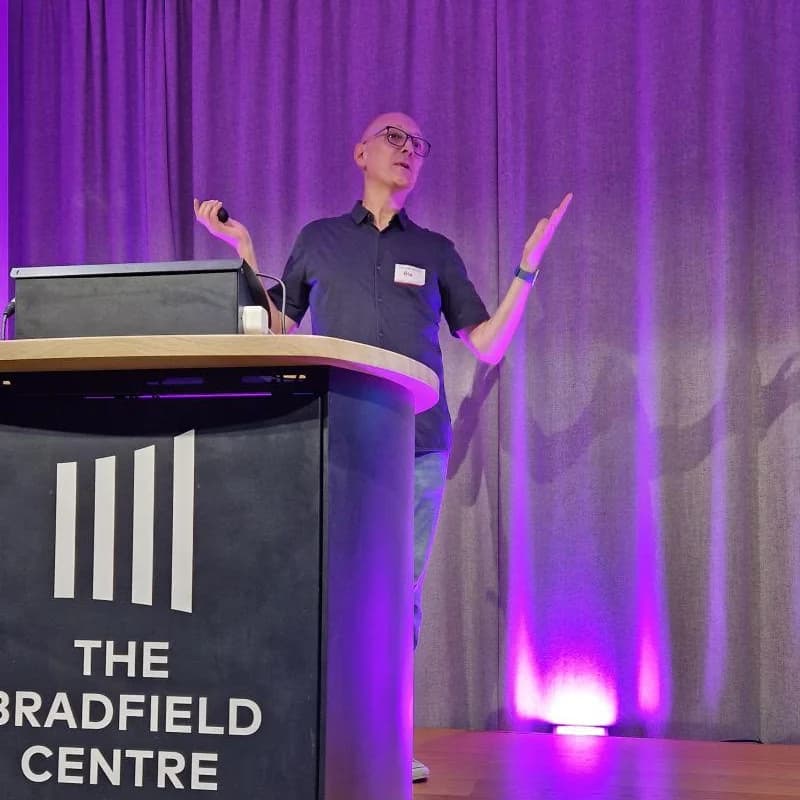
Photo from the talk, The Bradfield Centre, Cambridge
AI can copy your words. It can't copy the things that make people believe you.
That was my talk, given at The Marketing Meetup's Cambridge chapter on 22 September, hosted by Jon Torrens at The Bradfield Centre, organised by Christian Pratt and the rest of the TMM Cambridge team: Michelle Lamprecht, Becky Lamont, Felicity Rose, Patrick Dao, Baz Richardson, and Chris Measures.
Brand is the prior, not the pitch
Erdem and Keane's 1996 Bayesian model of brand choice, published in Marketing Science, treats a buyer's existing belief about a brand as a prior: new evidence updates it, but the prior does most of the work. AI answer systems behave the same way. They're built from what others say about you, not what you say about yourself. A weak prior doesn't get fixed by publishing more.
I checked, on my own data, and it didn't
I've been running a constant check of my own AI visibility since April, 5,095 checks by September, one query on one platform each time. I published a GEO-versus-AEO article on 9 July and an AI-visibility whitepaper on 13 July. Neither moved a single query it was written for, not once, over ten weeks of checking. Content doesn't build the prior. Something else does.
What actually builds it
Case studies from real experience. Earned media. Analyst and review-site presence. Community and events. Visible people, not company accounts. A named person, speaking under their own name, in a room like the Cambridge one, is exactly the mechanism asking to be fed. At Redgate, a £100,000 deal traced back to one salesperson's rapport on a single call. You could hear it in the recording. Emotional intelligence wasn't the nice-to-have around that deal. It was the deal.
The boardroom version
Most boards don't understand brand marketing and don't fund it. They do understand AI. Show a board its visibility in AI answers, then show that brand work is what moves that number, and the conversation changes. That's the pitch for the £200k, not "trust me."
What's left for you to do
Own a number, not just activity. Bring real buyer insight instead of assumption. Match your focus to your company's stage. AI can draft the pipeline report. It can't be accountable for the win rate.
Why the room mattered
I last gave this talk in 2019. I have a brain injury now, and a talk like that one is not easy for me anymore. Cambridge Marketing Meetup made it possible anyway, and that's not a small thing to say out loud. Being real is the whole argument of the talk, so it seemed dishonest not to be real about that part too.
Brand is how you impact GEO
Brand impact has always been hard to measure. Generative engines, which have to synthesise a point of view, finally make it visible.
Most B2B marketing revenue doesn't come from discovery. It comes from people who already know you.
Most early-stage B2B revenue traces back to people you already knew, not to search or campaigns. Relationship-mediated buying is the main mechanism, and marketing strategy should be built around it.
Testing whether I should reuse old content
I fit a hierarchical Bayesian model to test whether retitling old content for AI citation works, and a robustness check collapsed the one clean result it found.
My AI visibility went from zero to 26% in six weeks. The one category still at zero is the one this post is about.
Six weeks after publishing a zero-appearance rate across every AI platform, most categories moved. The one still at zero is AI Search Visibility itself.