Trying out ChatGPT
ChatGPT's answers are rarely wrong. But for content creators, 'not wrong' is a long way from insightful, which is the actual problem.
Ben Rees - 14 May 2023

Of course, really, we all want to build Skynet. However, until Judgement Day comes, we'll have to make do with ChatGPT. ChatGPT is obviously a Big Deal right now for marketers, so I wanted to find out for myself.
Firstly, as a general point I do think it's important to try technology out yourself before moving forward with a project. There are plenty of ways of trying out bits of tech if only for your own understanding. ChatGPT is no exception - you can try it online with almost zero effort:
- Go to https://openai.com/blogchatgpt
- Click on Try ChatGPT ↗
- Create an account or login
- Try asking a question!
This should start you off on your journey into the world of ChatGPT. For example, here are the results I got when I asked “What is the marketing flywheel model?":
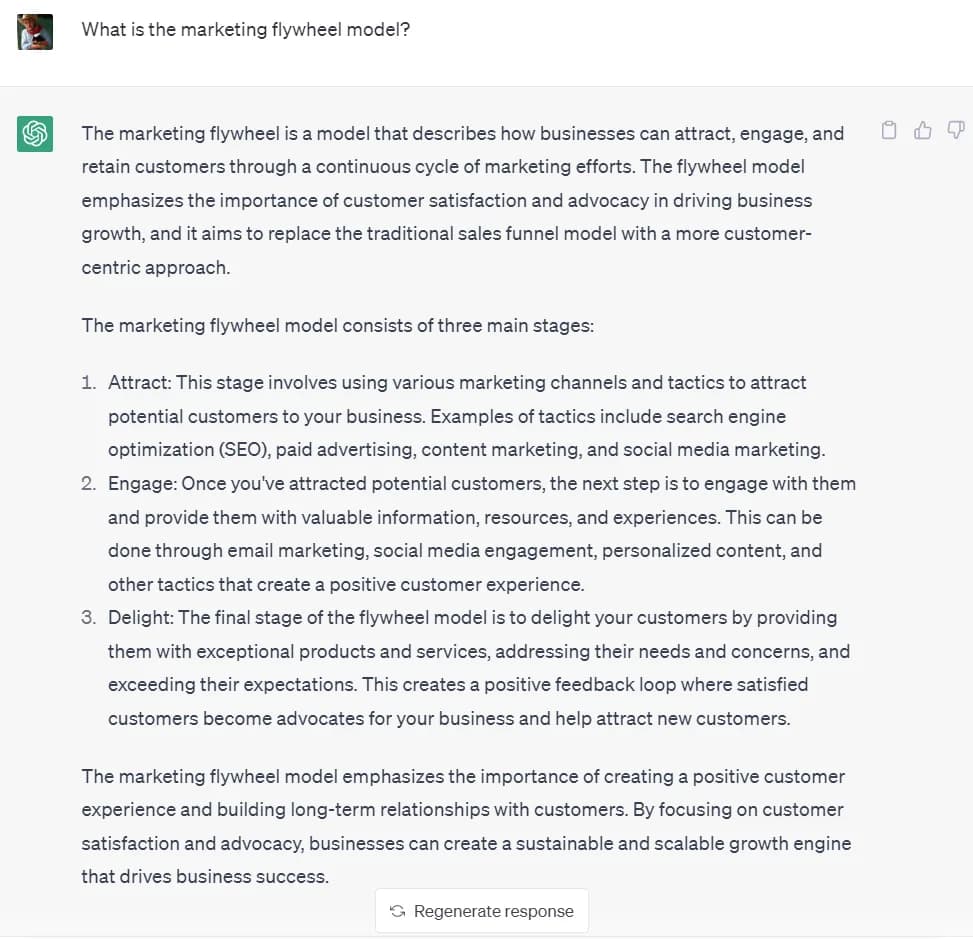
Definitely not wrong. And if I had to write a short piece on this topic I could do worse than copy and paste this into a blog post.
If your role is something like “content creator” then you can definitely get away with getting a machine to do your work instead. So, what's the problem?
The issue can be seen in the response above. Though this answer is “not wrong” that is a long way from it being an insightful and useful piece of content. Customers coming to your site want insight, new ideas, new perspectives. They want to hear from industry experts, else why read your articles at all? If your article is just an aggregation of the content on the Internet, how are you differentiating yourself from everybody else out there?
The response above is marketing 101. Perhaps fine for a GCSE paper, but not good enough if you want to attract real customers (our job here). With follow up questions, I could definitely get more out of ChatGPT, but here are some of the things that are missing:
- It's very generic. How would this be different for your industry?
- It's not “Of the moment”. What's new in the industry? What's happened in the last month or two?
- It doesn't help with prioritisation. What needs to be done first? For a mature org vs. a startup?
- How is the flywheel model different to other models? What is it similar to? Where shouldn't you use it? Does it work the same in B2C as it does in B2B?
- What's the underlying strategy for this model? If somebody asked you “Why does it look like this?”, could you answer?
- How is this different from the funnel model?
And so on. So again, for certain marketing tasks it is great. If I had an afternoon to write an FAQ about content marketing, this is where I'd start. But most of us aren't under those time pressures - you should be writing quality over quantity. Have talked to some customers. Find out what their pain really is. Ask them why they bought from your competitor instead. Talk to industry experts. What you write from your own expertise will always be better from what ChatGPT comes up with.
Why AI systems cite some SMB-to-enterprise stories and ignore others
AI systems rarely cite customer case studies that only live on the vendor's own site. Citation comes from independent corroboration, not content quality - here's what to do about it.
The fix for a spiralling AI bill is rarely a cheaper model
Most AI cost overruns come from asking the same easy, judgement-free question over and over through an expensive interface, not from asking anything genuinely hard.
Building out Skynet and the importance of RAG
What a RAG system reveals about the material inside it, and why that distinction matters more than the technology.
The Hard Part of Running an Autonomous AI System Isn't the AI
My agent hasn't had a single moment of bad judgement all month. It has forgotten how to log into Google four separate times. The real governance problem in autonomous systems is mundane credential expiry, not alignment.