How My Approach to Marketing Differs from the Standard Playbook
You need to do something different to be seen
Ben Rees - 10 December 2025

How do you avoid producing AI slop?! Or perhaps more precisely, how do we articulate our value in a way that doesn't just copy everybody else and leave the customer bored?
I have done a bit of work to try and figure out how my approach to marketing is different from what most other people do. Obviously these aren't quite the 10 commandments, but I have found over the years that these are the principles that have worked for me, generating high value opportunities for the business (i.e. our job!).
1. Start from the customer’s reality, not your product narrative
Customers bring their own assumptions, constraints, and mental shortcuts. If you ignore that, your messaging becomes internal fiction. Start where they are, not where you wish they were. See: How to conduct customer interviews.
Example: When customers described a product as “a simpler alternative to X,” I adopted their language. Conversions improved immediately.
2. Take the red pill of reality over internal wishful thinking
Don’t assume customers will “get it eventually.” They update based on what they already believe and what they see now, not on our internal narratives. Accepting what customers already think unlocks more progress than trying to reshape their mental models. See: Making decisions in a Bayesian world.
Example: A team insisted buyers would learn why their workflow was better. They didn’t. Reframing around existing beliefs shortened sales cycles overnight.
3. Treat customer value as the organising principle of marketing
If customers fund the entire company, then their outcomes should dictate the strategy. Vanity metrics only distract from reality. Anchor the team on what genuinely helps customers succeed and let that determine priorities. See: B2B Marketing Measurement.
Example: I removed an MQL dashboard because nothing correlated with revenue. Focusing on actual customer outcomes made decisions easier.
4. Under-promise and over-deliver as a deliberate strategy
Lowering expectations slightly creates space for the product to impress rather than disappoint. The gap between promise and experience is where delight forms, and delight drives advocacy. See: Focus on quality – lessons from Zen and the Art of Motorcycle Maintenance.
Example: When we softened PLG onboarding claims, usage increased. Expectations became realistic, so the product could pleasantly surprise.
5. Design messaging as expectation management, not persuasion theatre
Good messaging doesn’t manipulate. It sets clear expectations so the product experience feels coherent. When someone tries the product and finds exactly what they expected, behaviour becomes predictable and satisfaction increases. See: Why GEO Matters More Than SEO.
Example: Removing dramatic adjectives from a landing page reduced bounce rates because people finally understood what the product actually did.
6. Position outside-in before touching any channels
Channels amplify positioning; they don’t repair it. Before you distribute anything, define the market gap, the distinction, and the proposition. Without this foundation, you scale confusion rather than clarity. See: The Value of Positioning Statements for an Evolving Product.
Example: After repositioning into an unclaimed niche, content that had previously underperformed started to work immediately.
7. Use stricter criteria for differentiation
Most “differences” are irrelevant. Strong differentiation comes from attributes competitors cannot or will not match. These create defensibility and clarity, not just novelty. See: Marketing Pyramid v3.
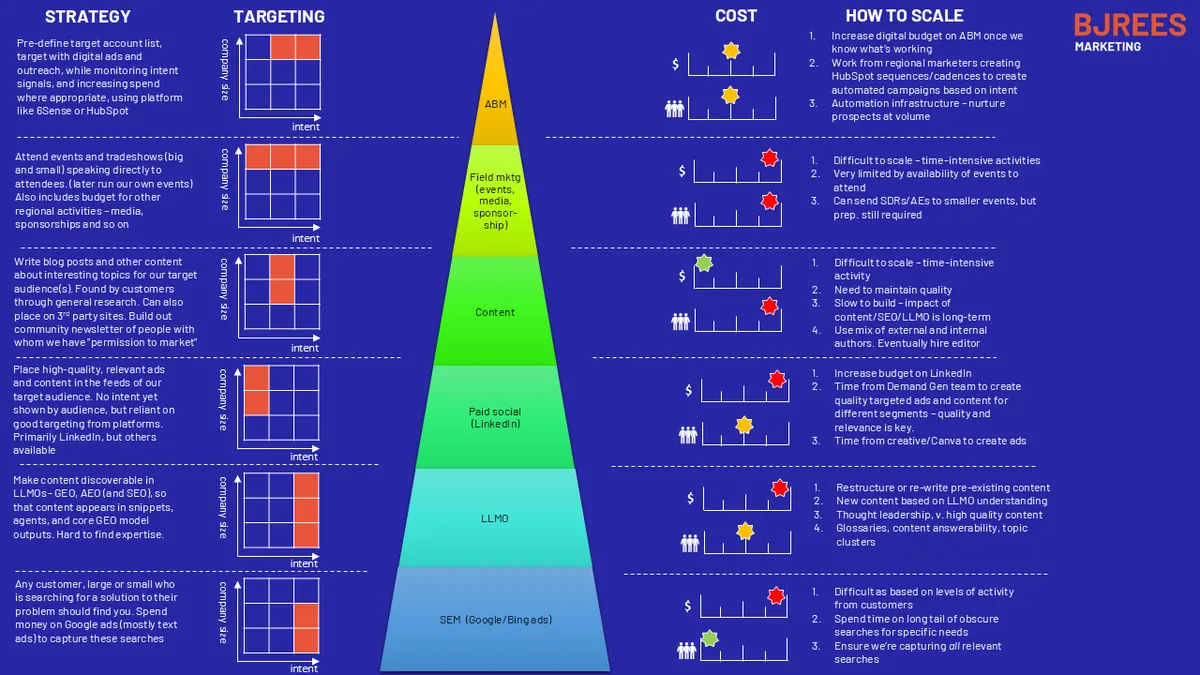
Example: Two products were nearly identical. One workflow constraint that competitors refused to support became the true differentiator.
8. Anchor marketing in culture, not consensus best practices
Execution quality is a cultural output. You can’t compensate for weak culture with checklists or templates. Openness and intellectual honesty allow teams to move quickly and fix problems early. See: Why company culture is so important in marketing.
Example: The best team I led shared failures more openly than successes. It removed defensiveness and dramatically improved the work.
9. Prefer opinionated ideas over me-too marketing
Consensus content is invisible. Distinctive ideas show confidence and attract attention because they actually take a position. Standing out requires the willingness to be specific — not vague. See: Slaying a few marketing myths.
Example: A post that contradicted a popular marketing trope outperformed months of keyword-led content because it had something to say.
10. Use lived experience as your compass, not generic advice
Real pattern recognition comes from experience: experiments, failures, and time spent with real customers. Generic advice averages out all the edges that make your situation unique. Trust the evidence you’ve earned. See: Building a Private Chatbot.
Example: I ignored a “best practice” funnel recommendation because it contradicted what I’d seen in enterprise sales. My instincts were right; the best practice wasn’t.
If you want support applying these ideas in your own organisation, get in touch at ben@bjrees.com.
All my best work is done on runs
..and as a Brucie Bonus, I'm getting fit too, as long as I stretch - https://youtu.be/u-e0ZO5L0s0
How to build a B2B marketing team
How to build a B2B marketing engine from scratch, what a VP of marketing actually does day to day, and what makes a great CMO: choose your strategy before you build the team, the shape of the strategy determines the people you need, not the other way round.
Daoism and Marketing Planning
Why the annual marketing plan gathers dust by February, and what the Dao of Complexity gets right about planning for emergence instead.
What makes a great company culture?
My personal views on what makes a great company culture