AI Visibility Is a Layered Problem
Before a brand can appear in an AI answer, it must first be legible to the system. A six-layer model for what that actually requires.
Ben Rees - 18 December 2025

As AI systems increasingly mediate how people discover and assess brands, visibility is no longer a function of ranking alone (the model we have all been used to for years). Before a brand can appear in an AI-generated response, it must first be legible to the system. It needs to be recognised as a coherent member of a category, consistently represented across contexts, and safe to select as a default answer.
This perspective draws directly on established work in marketing and cognitive science. Schema-based brand research shows that consumers do not evaluate brands as bundles of isolated attributes, but as organised mental structures with defaults and expectations (see Halkias).
Empirical studies of consumer search further demonstrate that familiarity and prior ownership shape attention long before an explicit query is made (see Ursu et al.). Large language models inherit these same structural biases because they are trained on human language, not abstract truth.
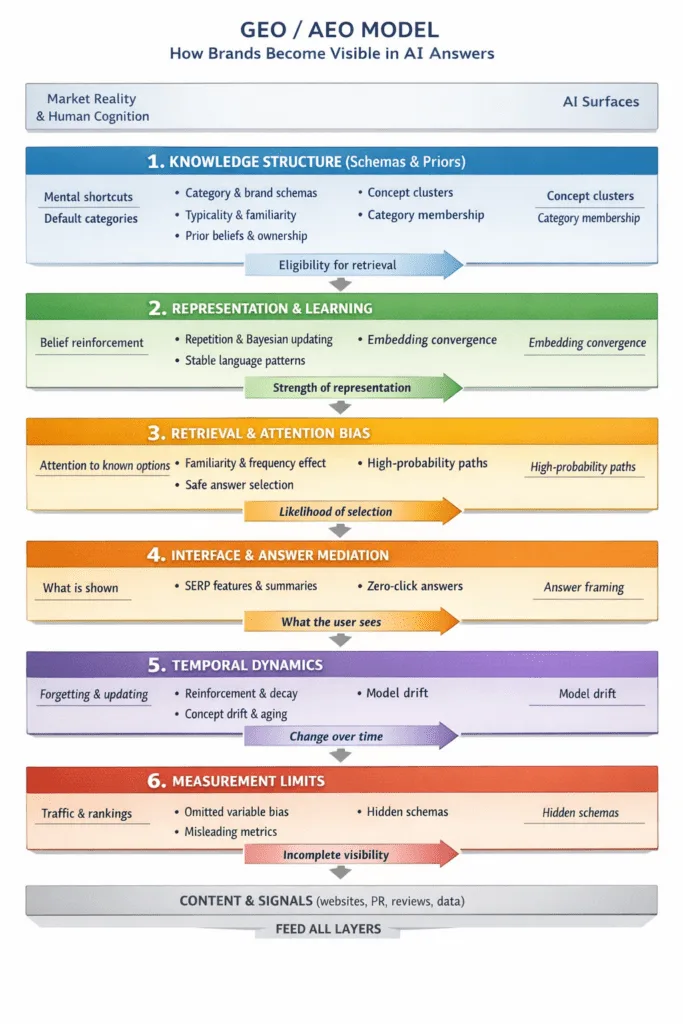
The model below captures this as a six-layer stack. These layers run from knowledge structure and learning at the base , through retrieval bias and interface mediation , to time-based decay and the limits of measurement at the surface.
Most marketing effort concentrates on the surface layers. In practice, AI visibility is largely determined much further down the stack.
This is part of a series, the end goal of which is to explain why you need a more analytical approach to marketing implementation and the importance of moving away from trying to do everything all at once with limited resource. And most impotantly that the decisions you make aren't based on gut instinct, but on sound scientific theory.
 AI Visibility
References
Halkias, G. Mental representation of brands: a schema-based approach to consumers’ organization of marketing knowledge. Journal of Product & Brand Management.
Ursu, R. M., Erdem, T., Wang, Q., Zhang, Q. Prior information and consumer search: Evidence from eye-tracking.
Vaswani, A. et al. Attention Is All You Need.
Erdem, T. Decision Making under Uncertainty: Capturing Dynamic Brand Choice Processes.
Erdem, T. Industrial Marketing as a Bayesian Process of Belief Updating.
GEO vs AEO: Why the Distinction Matters
AEO gets your content surfaced in AI-generated answers today; GEO shapes what AI systems already believe about your brand before the query is ever asked. For B2B buyers researching over weeks or months, ignoring GEO is the costlier mistake.
Brand visibility is now a Bayesian problem
How does brand affect AI search visibility? It's a Bayesian problem: if the model's prior on your brand is weak, no content strategy will fix it in the short term.
What a 2019 NLP paper tells us about getting recalled by AI
What a 2019 BERT paper by Petroni et al. reveals about how AI models store and recall facts - and why most brand content is optimised for the wrong thing.
AEO Visibility Decays Faster Than SEO
Generative search engines regenerate answers dynamically, so AI visibility decays far faster than SEO rankings ever did. Here's a framework for monitoring it.