Pirsigism
The platforms have inserted themselves into the relationship
Every step between your original thought and your customer compresses and distorts it. Marketing has spent decades adding more steps, not fewer.
Ben Rees - 12 June 2026

This was a line I heard on "The Rest is Entertainment" podcast this morning and it was talking about the music industry. But... it really made me think about marketing and advertising, what I do as a job.
In one of my favorite books, Zen and the Art of Motorcycle Maintenance, Robert Pirsig spent more than 400 pages talking about the notion of quality and how the closer you are to something real, the more quality survives. Every step away from direct contact reduces the quality of a piece of work.
Stick with me here, he was talking about fixing bikes, but I use this concept all the time when trying to do marketing work. Put plainly, "The further away you are from your customers, with more intermediaries, the less you truly understand them."
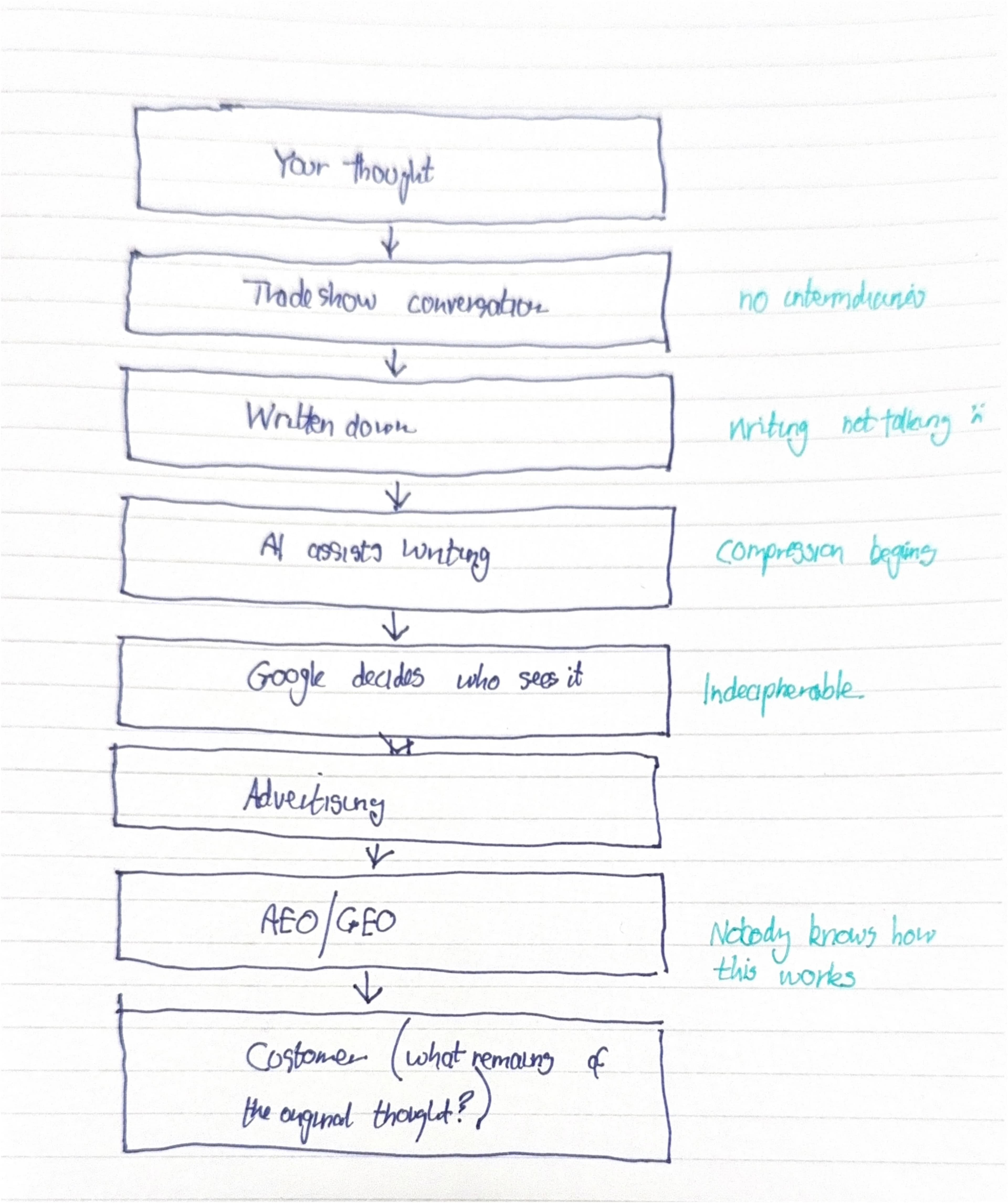
Here is an example, count the steps between your brainwave of how you could help a customer, and the reality:
You think of something and write it down. Great, if your customer could chat to you directly (in the way that a salesperson can), you would know directly what they want. This is why exhibitions and events are so good. I have personally bought 6sense because I went to talk to them at an event, the person on the booth listened, understood me perfectly, wrote everything down, came back to me in person the next day, 3 months later we bought.
Ok, you don't go to events, how do you find out about them? Perhaps you watched a video, or read a blog post, great. But even if that post was a video of the founder, it is still not interactive, you don't get as high a quality interaction.
Then, "content". You write things which you hope people will be interested in, even though it is to a mass audience. A long way from a 1:1 chat.
But it gets worse. You start using AI to write your copy and produce your ads/copy, not only have they never met a customer, they're not real!
Then advertising, AEO, GEO, each stage an abstraction away from the customer with their actual problem.
By the time your idea reaches someone it has passed through 5 or 6 compression, weighting and filtering processes, dumbing down the original idea.
This really is Information Theory, each transmission loses something.
An example. I thought I would try doing some strategy work 2 days after Claude Fable 5 was released. One query run cost me 75 pence but I thought "75p is a lot less than a day of a strategy consultant."
The output was not only imprecise, it was just plain wrong.
Language models are just non-linear function approximators (ish), they compress everything into structures that produce plausible output. What they can't do is hold a genuinely uncertain question and slowly reason through. This is an architectural limit, not a data problem.
I recorded this thinking on a Sony voice recorder and asked to transcribe the notes so that I wasn't trying to listen and write at the same time. But that's all.
So there is a spectrum. At one end talking to a customer in real life, at the other, AEO generated content that feeds into some bewildering Google machine that may or may not tell you what you need.
I wrote these pages by hand in a notebook with a pen. Yes, I have the handwriting of a 5-year-old, but at least you know this is a direct line from my thinking to the page.
The antipattern of enshittification isn't making our work better, it is removing intermediaries and getting as close to the customer as possible.
So, talk to your customers (Zoom is fine!), not NPS, not surveys. Actual conversations. The people who will be replaced by AI are not the strategic thinkers. Sadly it's the late intermediaries who are just using AI to interpret the interpretation of an interpretation of an interpretation...